


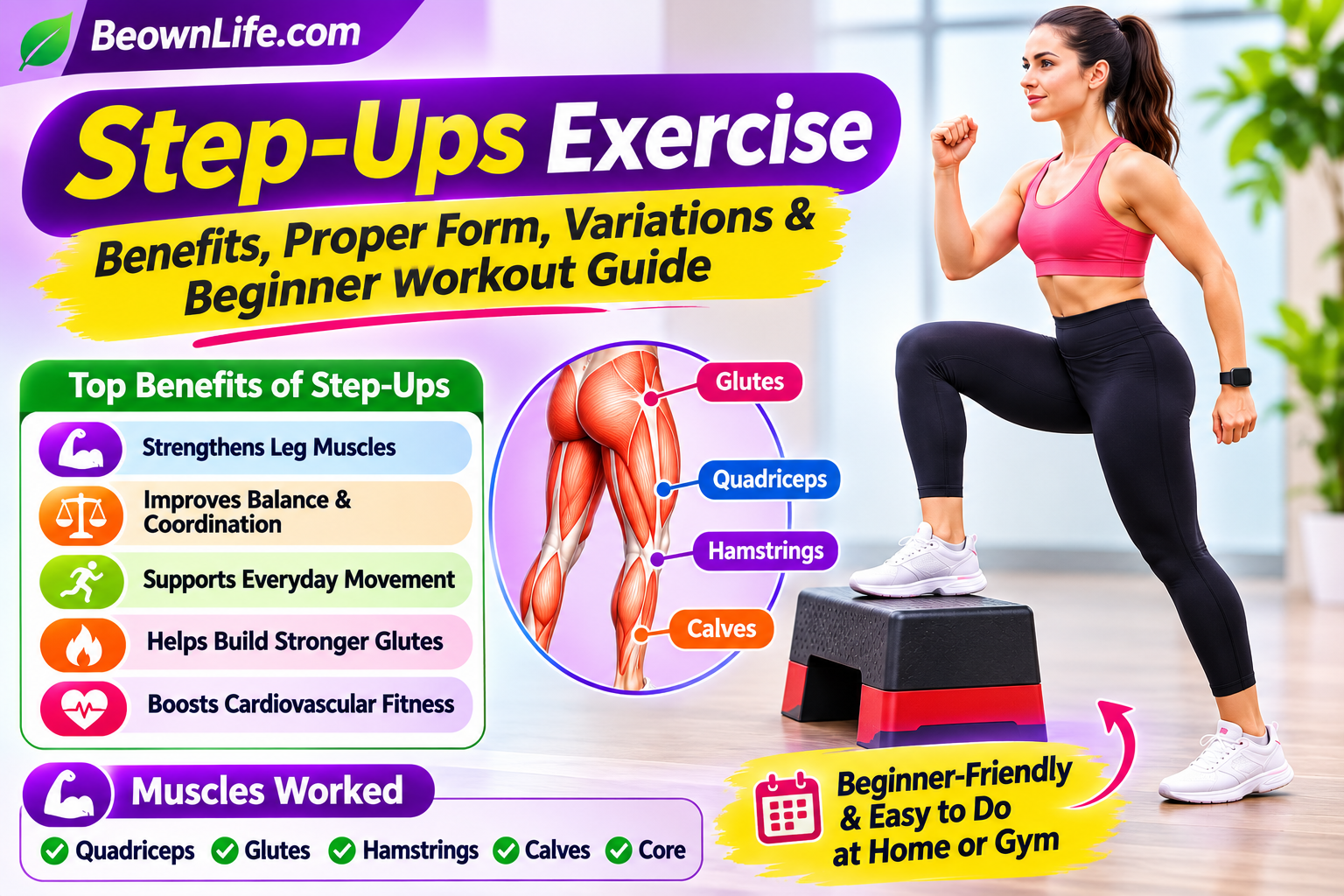
Looking for an effective lower-body exercise that you can perform at home or in the gym without expensive equipment? The step-ups exercise is an excellent option for people who want to strengthen their legs, improve balance, and develop functional fitness.
Step-ups are a simple bodyweight exercise that involves stepping onto an elevated platform, such as a sturdy workout step, exercise bench, or stable box, and then stepping back down in a controlled manner.
Although the movement looks easy, step-ups engage several important muscle groups, including your quadriceps, glutes, hamstrings, and calves. They also challenge your balance, coordination, and core stability.
Whether you are a beginner starting a home workout routine, an experienced gym enthusiast, or someone looking to improve everyday mobility, step-ups can be a valuable addition to your exercise program.
In This Guide:
- What are step-ups?
- Muscles worked during step-ups
- Top health and fitness benefits
- How to perform step-ups correctly
- Different step-up variations
- Common mistakes to avoid
- A beginner-friendly four-week workout plan
- Frequently asked questions
What Is a Step-Ups Exercise?
A step-up is a unilateral lower-body exercise that involves stepping onto an elevated surface using one leg at a time. The movement primarily works your thigh and hip muscles while also requiring balance and coordination.
The exercise closely resembles everyday activities such as climbing stairs, walking uphill, and stepping onto a raised platform.
You can perform step-ups using:
- A sturdy aerobic step platform.
- A stable workout bench designed for exercise.
- A secure exercise box.
- A low, stable step specifically designed for fitness training.
Fitness Tip:
If you are a beginner, start with a low step. You do not need a high platform to get an effective workout. Proper movement and controlled technique are more important than step height.
Which Muscles Do Step-Ups Work?
Step-ups target several muscles in your lower body. Different muscles work together to lift your body onto the platform and control your movement as you step back down.
🦵 1. Quadriceps
The quadriceps are located at the front of your thighs. They help straighten your knee and play an important role in lifting your body onto the platform.
🍑 2. Glutes
Your gluteal muscles help extend your hips and provide power as you step onto the elevated surface.
💪 3. Hamstrings
Located at the back of your thighs, the hamstrings assist with hip movement and help stabilize your lower body.
🦶 4. Calves
Your calf muscles help stabilize your ankles and contribute to controlled movement during step-ups.
🔥 5. Core Muscles
Your abdominal and trunk muscles help maintain balance and keep your body stable throughout the exercise.
⚖️ 6. Hip Stabilizers
Muscles around your hips help control pelvic movement and maintain balance when standing on one leg.
Top 9 Benefits of Step-Ups Exercise
Step-ups are more than just a leg exercise. When included in a balanced fitness routine, they offer several benefits that support everyday movement and overall physical fitness.
1. Strengthens Your Leg Muscles
One of the biggest benefits of step-ups is improved lower-body strength. The movement challenges your quadriceps, glutes, hamstrings, and calves as you lift your body against gravity.
Regular strength training can help make everyday activities such as walking, climbing stairs, and standing up from a chair easier.
2. Improves Balance and Coordination
Because step-ups involve lifting one leg and supporting your body with the other, they challenge your balance and coordination.
Practicing controlled step-ups can help develop better movement awareness and lower-body stability.
3. Supports Everyday Functional Movement
Climbing stairs, stepping onto a curb, and walking up a hill are common daily activities.
Step-ups closely resemble these movements, making them a useful functional exercise for developing practical lower-body strength.
4. Develops Single-Leg Strength
Step-ups train one leg at a time, helping you identify and work on differences in strength and control between your left and right sides.
This makes them a useful addition to unilateral strength-training programs.
5. Helps Strengthen Your Glutes
Your glutes play a major role in extending your hips and lifting your body during a step-up.
Performing controlled step-ups can help strengthen your hip muscles and complement other glute-focused exercises.
6. Can Improve Cardiovascular Fitness
Step-ups involve repeated whole-body movement and can increase your heart rate, particularly when performed continuously at a moderate pace.
They can be incorporated into circuit workouts to add a cardiovascular challenge alongside muscular training.
7. Supports Weight Management
Step-ups use energy and involve several large muscle groups. They can contribute to an active lifestyle and support a broader weight-management program.
For meaningful fat loss, combine regular physical activity with a sustainable nutrition plan and appropriate calorie intake.
8. Requires Minimal Equipment
You do not need an expensive gym membership or complicated exercise machines to perform step-ups.
A stable fitness step and comfortable athletic shoes are generally enough to get started.
9. Easily Adaptable to Different Fitness Levels
Beginners can use a low platform and bodyweight resistance, while experienced exercisers can increase the challenge by adding dumbbells or changing the exercise variation.
This makes step-ups a flexible exercise for different workout goals.
How to Do Step-Ups Correctly: Step-by-Step Guide
Using proper form is important for maximizing the benefits of step-ups and reducing unnecessary stress on your knees, hips, and ankles.
Before You Start:
Choose a sturdy, nonslip exercise platform. Make sure it cannot slide or tip over. Start with a low step that allows you to maintain good control.
Step 1: Stand in Front of the Platform
Stand facing a stable step or exercise platform. Keep your feet approximately hip-width apart and your posture upright.
Step 2: Place One Foot on the Step
Lift your right foot and place your entire foot securely on the platform. Make sure your heel and forefoot are supported.
Step 3: Push Through Your Front Foot
Press through the foot on the platform and extend your hip and knee to lift your body upward.
Avoid relying heavily on the foot that remains on the floor.
Step 4: Stand Tall on the Platform
Bring your other foot onto the platform. Stand upright and maintain your balance without locking your knees forcefully.
Step 5: Step Down Slowly
Carefully lower one foot back to the floor, followed by the other. Control your movement instead of dropping down quickly.
Step 6: Repeat With the Other Leg
Repeat the movement using your opposite leg. Continue alternating sides or complete all repetitions on one side before switching.
Important Technique Tip:
Keep your knees aligned with your toes, maintain a stable torso, and avoid pushing excessively with your trailing leg. Quality repetitions are more valuable than rushing through the exercise.
Different Types of Step-Ups to Try
Once you master the basic step-up, you can experiment with different variations to challenge your muscles and keep your workout interesting.
1. Basic Bodyweight Step-Ups
This is the best starting point for beginners. Use a low platform and perform the movement without additional weights.
- Stand in front of the platform.
- Place one foot securely on the step.
- Push through your front foot.
- Stand tall and step down slowly.
- Alternate legs for each repetition.
2. Dumbbell Step-Ups
This variation increases resistance and makes the exercise more challenging for experienced individuals.
- Hold a light dumbbell in each hand.
- Keep your arms relaxed at your sides.
- Perform the standard step-up movement.
- Use a weight that allows you to maintain control.
3. Lateral Step-Ups
Instead of facing the platform directly, stand beside it and step sideways onto the surface.
This variation introduces a different movement pattern and challenges hip and leg coordination.
4. Knee Drive Step-Ups
After stepping onto the platform, lift your opposite knee toward your chest in a controlled movement.
This adds a balance and coordination challenge. Begin without weights and use a stable platform.
5. Weighted Step-Ups
Experienced exercisers can use dumbbells or other suitable resistance to increase training intensity.
Start with a light load and increase it gradually while maintaining proper technique.
6. Reverse Step-Downs
Begin standing on a low platform and slowly lower one foot toward the floor while keeping the other foot on the step.
This controlled variation emphasizes eccentric leg strength. It can be challenging, so begin with a low step and appropriate support if needed.
Common Step-Ups Mistakes to Avoid
Even though step-ups are relatively simple, improper technique can reduce their effectiveness and increase unnecessary strain.
❌ 1. Using a Step That Is Too High
A high platform can make it difficult to maintain proper knee and hip alignment.
Solution: Start with a lower step and increase the height only when you can perform the movement comfortably.
❌ 2. Pushing Too Much With the Back Foot
Using the floor leg to jump or push excessively reduces the training demand on the leg placed on the platform.
Solution: Focus on controlled pressure through the foot on the step.
❌ 3. Allowing Your Knee to Collapse Inward
Your knee should generally follow the direction of your toes.
Solution: Maintain controlled knee alignment throughout the movement.
❌ 4. Moving Too Quickly
Rushing through repetitions can make it harder to maintain balance and control.
Solution: Step up and down slowly, focusing on proper technique.
❌ 5. Using Too Much Weight
Heavy dumbbells can compromise your balance and movement quality.
Solution: Master bodyweight step-ups before adding external resistance.
How Many Step-Ups Should You Do?
The ideal number of repetitions depends on your fitness level, training goals, and ability to maintain proper technique.
| Fitness Level | Repetitions | Sets | Rest |
|---|---|---|---|
| Beginner | 8–10 per leg | 2 | 60–90 sec |
| Intermediate | 10–12 per leg | 2–3 | 60–90 sec |
| Advanced | 12–15 per leg | 3 | 60–120 sec |
These are general starting guidelines. You may need fewer repetitions if you are new to exercise or using a higher platform.
4-Week Step-Ups Workout Plan for Beginners
If you want to include step-ups in your weekly fitness routine, follow this gradual four-week plan.
Your Beginner Goal:
Build lower-body strength, improve balance, and become comfortable performing controlled step-ups without rushing.
| Week | Reps Per Leg | Sets | Frequency |
|---|---|---|---|
| Week 1 | 8 | 2 | 2 days/week |
| Week 2 | 10 | 2 | 2–3 days/week |
| Week 3 | 10–12 | 2–3 | 3 days/week |
| Week 4 | 12 | 3 | 3 days/week |
Allow recovery between challenging sessions. If you cannot maintain good form, repeat the previous week’s level rather than increasing repetitions.
Progression Tip:
Increase only one training variable at a time, such as repetitions, sets, or resistance. You do not need to increase everything simultaneously.
Can Step-Ups Help With Weight Loss?
Step-ups can be part of a weight-loss workout because they involve repeated movement and engage several large muscle groups.
However, step-ups alone will not automatically cause significant fat loss. Your overall activity level, eating habits, calorie intake, sleep, and consistency all play important roles.
If your goal is to lose body fat, combine step-ups with:
- Brisk walking or other cardiovascular exercise.
- Full-body resistance training.
- A balanced diet with adequate protein.
- A sustainable calorie deficit.
- Regular sleep and recovery.
Remember:
You cannot specifically target thigh or belly fat through step-ups. Overall fat loss requires a consistent approach to nutrition and physical activity.
Who Should Be Careful When Doing Step-Ups?
Step-ups are suitable for many healthy adults, but certain people may need to modify the exercise or seek professional guidance before starting.
Be particularly careful if you have:
- Existing knee or hip pain.
- A recent ankle or lower-body injury.
- Balance or coordination difficulties.
- Significant joint problems.
- A medical condition that limits physical activity.
⚠️ Exercise Safety Warning
Always use a stable platform that cannot move or tip over. Avoid jumping onto an elevated surface if you are a beginner.
Stop exercising if you experience sharp pain, dizziness, chest discomfort, or unusual shortness of breath. Seek appropriate medical advice when necessary.
If you have an existing injury or medical condition, consult a qualified healthcare professional or physical therapist before beginning a new exercise routine.
Frequently Asked Questions About Step-Ups
1. Are step-ups a good exercise for beginners?
Yes. Step-ups can be beginner-friendly when performed on a low, stable platform. Start with bodyweight and focus on controlled movement.
2. What muscles do step-ups work the most?
Step-ups primarily target the quadriceps and glutes. They also involve the hamstrings, calves, core, and hip stabilizers.
3. How many step-ups should I do per day?
A beginner can start with 2 sets of 8–10 repetitions per leg, two times per week. Adjust the volume according to recovery and fitness level.
4. Are step-ups better than squats?
Neither exercise is universally better. Step-ups train one leg at a time and challenge balance, while squats train both legs through a different movement pattern. Both are useful in a balanced workout routine.
5. Can step-ups build bigger glutes?
Step-ups can strengthen your glute muscles. For greater muscle growth, gradually increase resistance and combine step-ups with other progressive glute exercises.
6. What is the best step height for beginners?
A low platform of approximately 4–8 inches can be a practical starting point for many beginners. Choose a height that allows you to step up without excessive knee bending or loss of balance.
7. Can I do step-ups at home?
Yes. You can perform step-ups at home using a purpose-built, stable exercise step. Avoid unstable household furniture, chairs, or surfaces that could tip over.
8. Do step-ups help improve balance?
Yes. Step-ups challenge your ability to control your body while transferring weight from one leg to the other. Regular practice can help develop balance and coordination.
9. Should I use dumbbells for step-ups?
Beginners should first master bodyweight step-ups. Once you can perform them comfortably with good technique, you may gradually introduce light dumbbells.
Final Thoughts: Add Step-Ups to Your Fitness Routine
The step-ups exercise is a simple yet effective way to strengthen your lower body, improve balance, and develop functional fitness. Because it works several muscle groups at the same time, it can be a valuable addition to both home and gym workouts.
Whether your goal is to strengthen your quadriceps, build stronger glutes, improve stair-climbing ability, or support your overall fitness, step-ups offer a practical training option.
Start with a low platform, use your bodyweight, and focus on proper technique. As you become stronger and more confident, gradually increase your repetitions or introduce additional resistance.
Remember that consistency is more important than intensity. You do not need to perform hundreds of repetitions to make progress. A balanced workout routine, proper nutrition, and adequate recovery will help you work toward your fitness goals.
Your Fitness Challenge Starts Today! 💪
Start with 2 sets of 8 step-ups per leg, practice good form, and gradually build your strength one workout at a time.
References and Further Reading
Medical Disclaimer: This article is intended for educational and informational purposes only. It does not replace professional medical advice, diagnosis, or treatment. Consult a qualified healthcare professional before starting a new exercise program, particularly if you have an existing injury or medical condition.

