


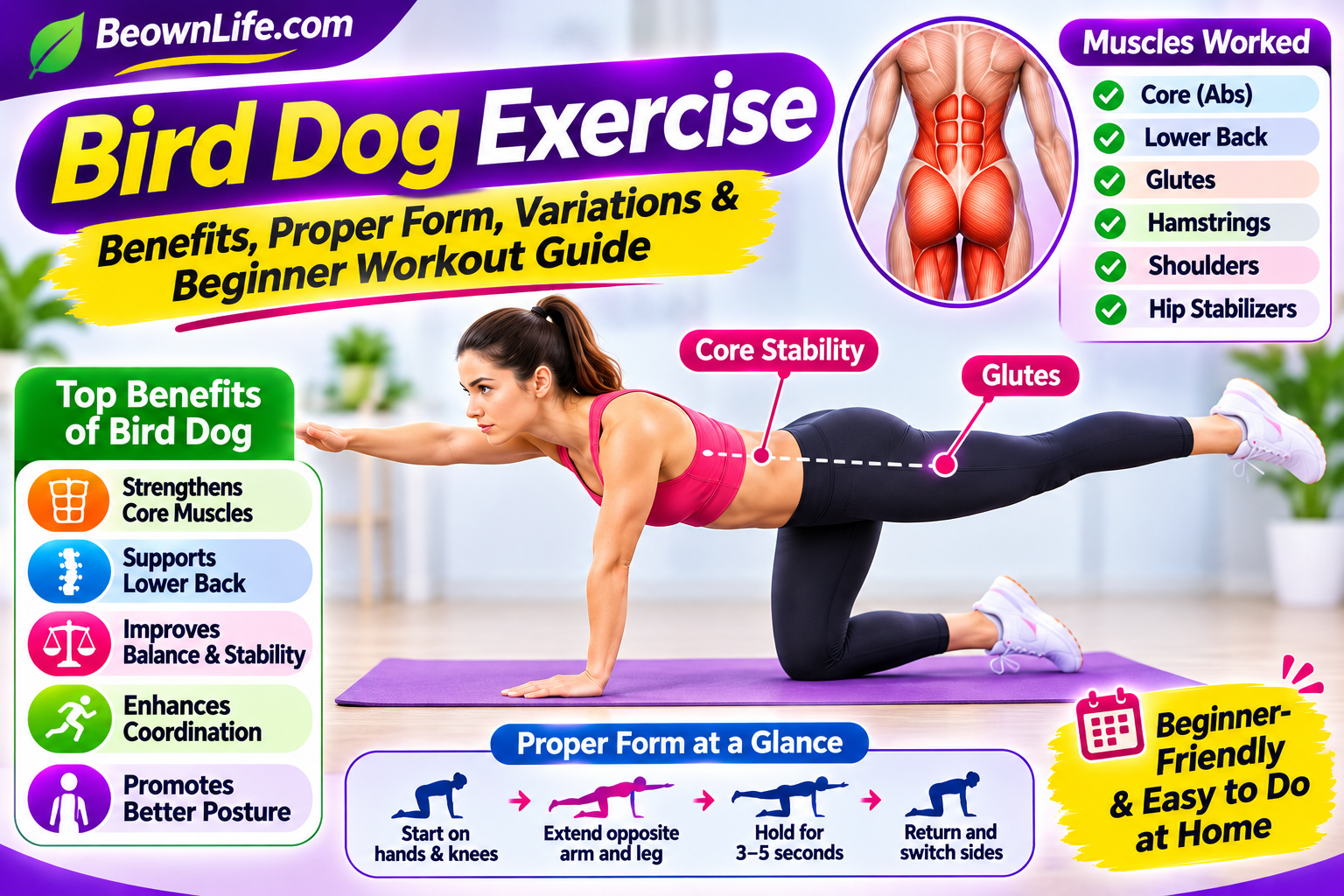
Looking for a simple exercise that can strengthen your core, improve balance, and support a healthy back without expensive gym equipment? The bird dog exercise is an excellent option to consider.
The bird dog is a bodyweight exercise performed on your hands and knees. You extend one arm forward while simultaneously extending the opposite leg backward, creating a straight line through your body.
Although the movement looks simple, it challenges several important muscle groups, including your abdominal muscles, back muscles, glutes, shoulders, and hips.
Unlike high-intensity exercises that involve rapid movements, the bird dog focuses on controlled movement, balance, coordination, and core stability.
Whether you are a beginner, someone who prefers home workouts, or a fitness enthusiast looking to improve core strength, this exercise can be a valuable addition to your routine.
What You’ll Learn in This Guide
- What the bird dog exercise is.
- Which muscles the exercise works.
- Top benefits of bird dog exercise.
- How to perform it correctly, step by step.
- Beginner and advanced bird dog variations.
- Common mistakes and how to avoid them.
- A four-week beginner workout plan.
- Frequently asked questions.
What Is the Bird Dog Exercise?
The bird dog exercise is a bodyweight core stability movement that involves extending one arm and the opposite leg while maintaining a stable position on your hands and knees.
The exercise gets its name from the position your body creates when your opposite arm and leg extend in different directions, somewhat resembling a pointing hunting dog.
It is commonly included in:
- Core strengthening programs.
- Bodyweight workout routines.
- Balance and coordination training.
- General fitness programs.
- Some physical therapy and rehabilitation programs.
One of the main goals of the bird dog exercise is to resist unwanted movement in your spine and pelvis while your arms and legs move.
Fitness Fact:
The bird dog is primarily a core stability exercise, not simply an arm or leg workout. Your abdominal and back muscles work together to keep your torso steady throughout the movement.
Which Muscles Does the Bird Dog Exercise Work?
The bird dog activates several muscle groups throughout your body. Some muscles help extend your limbs, while others stabilize your spine, hips, and shoulders.
🔥 1. Core Muscles
Your abdominal muscles, including the transverse abdominis and obliques, help stabilize your trunk and prevent excessive rotation.
💪 2. Back Muscles
The erector spinae and other spinal stabilizing muscles help maintain a neutral back position while your limbs move.
🍑 3. Gluteal Muscles
Your glutes help extend the hip when you move one leg backward and support pelvic stability.
🦵 4. Hamstrings
The hamstrings assist with hip extension and help control the movement of your extended leg.
🏋️ 5. Shoulder Muscles
Your shoulder stabilizers help support your body as one arm lifts away from the floor.
⚖️ 6. Hip Stabilizers
Muscles around your hips help maintain pelvic alignment and control unwanted movement.
Top 9 Benefits of Bird Dog Exercise
The bird dog is a simple exercise, but it offers several useful fitness benefits when performed consistently and with proper technique.
1. Strengthens Your Core
One of the biggest benefits of the bird dog exercise is improved core muscular endurance and stability.
Your abdominal muscles must work continuously to prevent your torso from rotating or your lower back from sagging.
This makes the bird dog a useful addition to a balanced core training routine.
2. Supports Spinal Stability
The bird dog trains your body to maintain a stable spine while your arms and legs move.
This type of controlled movement can help develop better trunk control and coordination.
It is often used in exercise programs designed to improve core stability.
3. Improves Balance and Coordination
Because you lift opposite limbs simultaneously, the exercise challenges your ability to maintain balance.
Regular practice can help develop body awareness and coordination between your upper and lower body.
4. Strengthens Your Glutes
Extending your leg backward activates your glute muscles, which are important for hip movement and stability.
The bird dog can complement other glute exercises such as bridges, squats, and lunges.
5. Encourages Better Movement Control
The exercise requires you to move slowly while keeping your torso stable.
This can help develop better control over your body position during everyday movements and other exercises.
6. Helps Train Hip Stability
Your hip muscles work to keep your pelvis level while one leg moves backward.
This makes bird dogs useful for practicing controlled hip movement without excessive pelvic rotation.
7. Requires No Gym Equipment
You do not need dumbbells, resistance machines, or an expensive gym membership to perform the bird dog exercise.
A comfortable exercise mat and enough floor space are generally all you need.
8. Beginner Friendly and Easy to Modify
Beginners can start by lifting only one arm or one leg at a time before progressing to the full movement.
More experienced individuals can explore advanced variations to increase the challenge.
9. Supports Functional Fitness
Core stability, coordination, and controlled movement are important for many everyday activities.
Bird dogs can help develop these physical skills as part of a well-rounded fitness program.
How to Do the Bird Dog Exercise Correctly: Step-by-Step
Proper technique is important for getting the most out of bird dogs. The goal is to extend your opposite arm and leg without allowing your lower back or pelvis to rotate excessively.
Before You Start:
Use a comfortable exercise mat or soft floor surface. Wear comfortable clothing that allows you to move freely.
Step 1: Start on Your Hands and Knees
Position yourself on all fours with your hands directly beneath your shoulders and your knees beneath your hips.
Keep your fingers spread comfortably and distribute your weight evenly between your hands and knees.
Step 2: Find a Neutral Spine Position
Keep your back in a natural, comfortable position.
Avoid rounding your back excessively or allowing your lower back to sag.
Look down toward the floor to keep your neck aligned with your spine.
Step 3: Engage Your Core
Gently tighten your abdominal muscles as if preparing for a light abdominal exercise.
Keep your torso stable and avoid shifting your weight unnecessarily.
Step 4: Extend One Arm Forward
Slowly lift your right arm and extend it forward until it is approximately level with your shoulder.
Keep your palm facing inward or toward the floor, and avoid rotating your torso.
Step 5: Extend the Opposite Leg Backward
At the same time, extend your left leg backward until it is approximately level with your hip.
Keep your toes pointing toward the floor and avoid arching your lower back.
Step 6: Hold the Position
Hold your extended arm and opposite leg in position for approximately 3–5 seconds.
Continue breathing normally while keeping your hips and shoulders as level as possible.
Step 7: Return to the Starting Position
Slowly bring your right arm and left leg back to the starting position.
Avoid dropping your arm or leg suddenly.
Step 8: Switch Sides
Extend your left arm forward and your right leg backward.
Repeat the same controlled movement on the opposite side.
Pro Technique Tip:
Imagine balancing a glass of water on your lower back. Your goal is to keep your torso steady while your opposite arm and leg extend.
7 Bird Dog Exercise Variations to Try
Once you become comfortable with the standard bird dog, you can try different variations to match your fitness level and training goals.
1. Beginner Bird Dog
This variation is suitable for people who are new to core training or need to develop basic movement control.
- Start on your hands and knees.
- Lift only your right arm forward.
- Return to the starting position.
- Repeat using your left arm.
- Next, practice lifting one leg at a time.
Learn to maintain a stable torso before combining opposite arm and leg movements.
2. Standard Bird Dog
This is the traditional version of the exercise.
Extend your opposite arm and leg simultaneously, hold briefly, and return to the starting position.
Focus on slow, controlled movements.
3. Bird Dog With Elbow-to-Knee Crunch
After extending your opposite arm and leg, slowly bring your elbow and knee toward each other underneath your body.
- Extend your right arm and left leg.
- Bring your right elbow and left knee toward each other.
- Extend them again.
- Return to the starting position.
This variation adds a dynamic movement to the exercise.
4. Bird Dog Hold
Instead of performing repeated movements, extend your opposite arm and leg and maintain the position for a longer controlled hold.
Start with 5–10 seconds and increase gradually if you can maintain proper form.
5. Resistance Band Bird Dog
Experienced exercisers can introduce a suitable resistance band to increase the challenge.
Use a secure setup that does not compromise your balance or spinal position. Master the bodyweight version first.
6. Bird Dog on a Stability Ball
This advanced variation involves performing the movement with your body supported by a stability ball.
It introduces additional balance demands and should only be attempted by people who already have good core control.
7. Weighted Bird Dog
Experienced individuals may use very light resistance while performing the bird dog.
However, adding weight is not necessary to benefit from the exercise. Proper control and alignment should always come first.
Common Bird Dog Exercise Mistakes to Avoid
Although the bird dog is a beginner-friendly exercise, incorrect technique can reduce its effectiveness and create unnecessary strain.
❌ 1. Arching Your Lower Back
Excessively arching your lower back when extending your leg can compromise spinal alignment.
Solution: Keep your abdomen gently engaged and extend your leg only as far as you can without arching your back.
❌ 2. Rotating Your Hips
Allowing your pelvis to rotate or tilt excessively makes it harder to maintain a stable position.
Solution: Keep both sides of your pelvis facing the floor.
❌ 3. Raising Your Leg Too High
Lifting your leg excessively can cause your lower back to arch.
Solution: Keep your extended leg approximately level with your hip.
❌ 4. Moving Too Quickly
Rushing through repetitions can reduce balance and movement control.
Solution: Extend your limbs slowly and maintain a brief controlled hold.
❌ 5. Looking Forward Instead of Down
Looking too far forward can create unnecessary neck extension.
Solution: Keep your gaze toward the floor and maintain a comfortable neck position.
❌ 6. Holding Your Breath
Holding your breath can make it harder to maintain a relaxed, controlled movement.
Solution: Breathe naturally throughout each repetition.
How Many Bird Dog Repetitions Should You Do?
The ideal number of bird dog repetitions depends on your fitness level, movement control, and training goals.
Here are some general starting guidelines:
| Fitness Level | Reps Per Side | Sets | Rest |
|---|---|---|---|
| Beginner | 5–6 | 2 | 45–60 sec |
| Intermediate | 8–10 | 2–3 | 45–60 sec |
| Advanced | 10–12 | 3 | 60 sec |
For each repetition, extend your opposite arm and leg, hold for approximately 3–5 seconds, and return with control.
Important:
These are general starting recommendations, not strict requirements. If your balance or technique begins to deteriorate, reduce your repetitions or take additional rest.
4-Week Bird Dog Workout Plan for Beginners
If you are new to core training, this simple four-week plan can help you gradually develop better stability, coordination, and movement control.
Your Four-Week Goal:
Learn proper bird dog technique, strengthen your core stabilizers, and improve your ability to maintain balance during controlled movement.
| Week | Reps Per Side | Sets | Frequency |
|---|---|---|---|
| Week 1 | 5 | 2 | 2 days/week |
| Week 2 | 6 | 2 | 2–3 days/week |
| Week 3 | 8 | 2–3 | 3 days/week |
| Week 4 | 10 | 3 | 3 days/week |
Hold each repetition for approximately 3–5 seconds. Rest between sets and allow adequate recovery between challenging sessions.
Progression Tip:
Do not rush to increase repetitions. First make sure you can perform every movement without excessive back arching, hip rotation, or loss of balance.
Can Bird Dog Exercises Help With Lower Back Pain?
The bird dog is commonly included in core stabilization and rehabilitation exercise programs because it trains the muscles that help control your trunk and pelvis.
It can help people practice maintaining a stable spine while moving their arms and legs.
However, the exercise is not a guaranteed treatment for back pain, and its suitability depends on the individual’s condition and symptoms.
If you are experiencing persistent lower back discomfort, a healthcare professional or physical therapist can help determine whether bird dogs are appropriate for you.
Helpful Tips:
- Start with a comfortable range of motion.
- Keep your spine in a neutral position.
- Avoid lifting your leg higher than your hip.
- Move slowly and maintain control.
- Stop if the exercise increases your pain.
Who Should Be Careful When Doing Bird Dog Exercises?
Bird dogs are generally accessible to many people, but some individuals may need to modify the exercise or seek professional advice before starting.
Be especially careful if you have:
- A recent back or spinal injury.
- Persistent lower back pain.
- Shoulder or wrist injuries.
- Recent hip or abdominal surgery.
- Balance or mobility limitations.
- A medical condition that restricts physical activity.
⚠️ Exercise Safety Warning
Do not force your arm or leg into a position that causes pain or discomfort.
Stop if you experience sharp pain, numbness, dizziness, or unusual symptoms.
If you have an existing injury or medical condition, consult a qualified healthcare professional or physical therapist before beginning a new exercise routine.
Frequently Asked Questions About Bird Dog Exercise
1. Is the bird dog exercise good for beginners?
Yes. The bird dog is beginner-friendly because it can be performed without equipment and modified by lifting one arm or one leg at a time.
2. What muscles does the bird dog exercise work?
It primarily challenges the core and spinal stabilizers while also involving the glutes, hamstrings, shoulders, and hip stabilizers.
3. How many bird dog repetitions should I do?
Beginners can start with 5–6 repetitions per side for two sets. Gradually increase the repetitions as your control and endurance improve.
4. Does the bird dog exercise strengthen the lower back?
It trains the muscles that help stabilize your spine and trunk. It can complement a broader core-strengthening program but is not a guaranteed treatment for lower back pain.
5. Can I do bird dogs every day?
Some people may tolerate gentle daily practice, but two or three sessions per week are a reasonable starting point for beginners. Allow recovery when needed.
6. Are bird dogs good for core strength?
Yes. Bird dogs train your abdominal and back muscles to stabilize your torso while your opposite arm and leg move.
7. How long should I hold a bird dog?
A beginner can start with a 3–5-second hold for each repetition. More experienced exercisers may gradually increase the hold if they can maintain proper alignment.
8. Can bird dogs help improve posture?
Bird dogs can help develop core stability and movement control, which are useful components of overall postural conditioning. However, they are not a complete posture-correction program.
9. Are bird dogs better than planks?
Neither exercise is universally better. Planks develop static core endurance, while bird dogs challenge core stability during opposite arm and leg movements. Both can complement each other.
10. Can I do bird dog exercises at home?
Absolutely. You only need enough floor space and a comfortable exercise mat. No gym equipment is required.
Final Thoughts: Make Bird Dog Exercises Part of Your Fitness Routine
The bird dog is a simple yet effective bodyweight exercise that can help improve core stability, develop better balance, and strengthen the muscles responsible for controlling your spine and hips.
One of its biggest advantages is accessibility. You can perform bird dogs at home, at the gym, or almost anywhere without purchasing expensive fitness equipment.
Whether your goal is to improve core strength, develop better movement control, support spinal stability, or add variety to your home workout routine, the bird dog is a useful exercise to consider.
Start with a few controlled repetitions, focus on keeping your back and hips stable, and gradually increase the challenge as your fitness improves.
For the best overall results, combine bird dogs with other core exercises, resistance training, cardiovascular activity, balanced nutrition, and adequate recovery.
Your Fitness Challenge Starts Today! 💪
Start with 5 controlled repetitions on each side, stay consistent, and gradually build better core strength and stability. Small steps today can lead to meaningful fitness progress tomorrow!
References and Further Reading
Medical Disclaimer: This article is intended for educational and informational purposes only. It is not a substitute for professional medical advice, diagnosis, or treatment. Consult a qualified healthcare professional before beginning a new exercise program, particularly if you have an existing injury or medical condition.

