


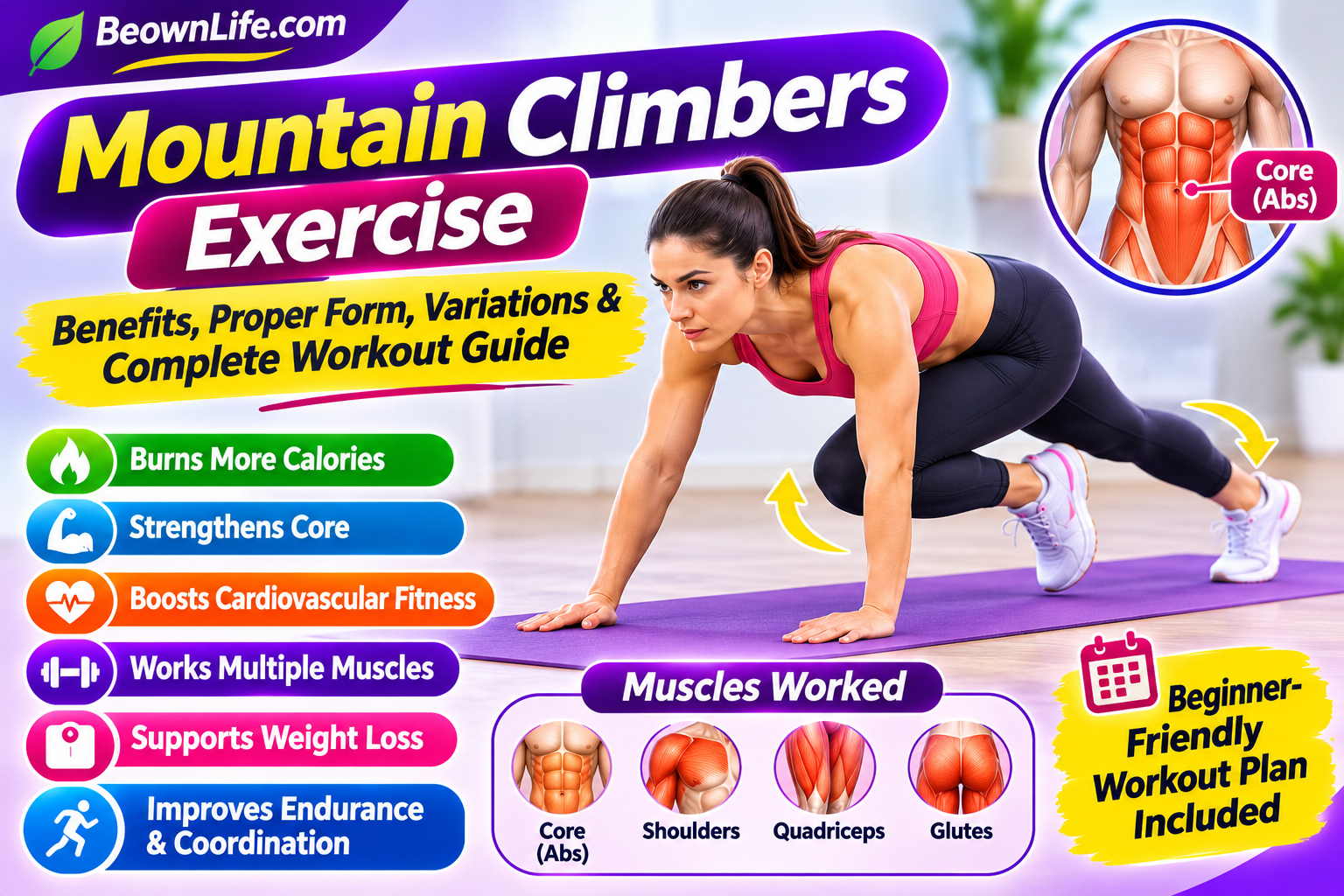
Looking for an exercise that challenges your entire body, gets your heart pumping, and requires absolutely no expensive gym equipment? The mountain climbers exercise might be exactly what you need.
Mountain climbers are a popular bodyweight exercise that combines a plank-like position with alternating knee drives. The movement resembles climbing a mountain, which is where the exercise gets its name.
Although mountain climbers look simple, they can provide a challenging workout for your abdominal muscles, shoulders, arms, hips, and legs. When performed at a faster pace, they also create a cardiovascular challenge that can help improve your overall fitness.
Whether you are a beginner working out at home, an experienced gym enthusiast, or someone looking to add variety to a fat-loss workout, mountain climbers can be a useful addition to your exercise routine.
What You’ll Learn in This Guide
- What mountain climbers are and how they work.
- Which muscles mountain climbers target.
- Top health and fitness benefits.
- How to perform mountain climbers correctly.
- Different variations for beginners and advanced exercisers.
- Common mistakes and how to avoid them.
- A practical four-week beginner workout plan.
- Frequently asked questions about mountain climbers.
What Are Mountain Climbers?
Mountain climbers are a dynamic bodyweight exercise performed from a high plank position. You support your upper body with your hands while alternately bringing your knees toward your chest.
Unlike traditional crunches or sit-ups, mountain climbers require you to stabilize your torso while continuously moving your legs.
This combination of core stabilization and repeated movement makes them a popular exercise in:
- Home workout programs.
- High-intensity interval training (HIIT).
- Full-body fitness circuits.
- Cardiovascular conditioning routines.
- Bodyweight strength and endurance workouts.
Fitness Fact:
Mountain climbers are a compound movement that involves multiple muscle groups at the same time. They challenge both muscular endurance and cardiovascular fitness, especially when performed continuously.
Which Muscles Do Mountain Climbers Work?
Mountain climbers engage several muscle groups throughout your body. Some muscles generate movement, while others stabilize your body and maintain proper posture.
🔥 1. Core Muscles
Your rectus abdominis, transverse abdominis, and oblique muscles help stabilize your torso and control your body during alternating knee drives.
💪 2. Shoulders
Your shoulder muscles help support your upper body while you maintain the high plank position.
🦵 3. Hip Flexors
Your hip flexors help bring your knees toward your chest during each repetition.
🏃 4. Quadriceps
The muscles at the front of your thighs help control your leg movement as you alternate between knee drives.
💪 5. Triceps
Your triceps help stabilize your elbows and maintain support through your arms.
🍑 6. Glutes
Your glute muscles contribute to hip stability and help maintain proper pelvic alignment.
🦶 7. Calves
Your calf muscles contribute to lower-leg stability and help control foot contact with the floor.
Top 9 Benefits of Mountain Climbers Exercise
Mountain climbers are popular because they combine core stabilization with continuous movement. When included in a balanced exercise program, they can offer several fitness benefits.
1. Strengthens Your Core
One of the biggest benefits of mountain climbers is the challenge they provide to your abdominal muscles.
Maintaining a stable plank position requires your core muscles to work continuously while your legs move.
This can help develop better core muscular endurance and trunk control.
2. Improves Cardiovascular Fitness
Mountain climbers involve repeated whole-body movement, which can increase your heart rate and breathing rate.
When performed at a moderate or fast pace, they can be included in cardiovascular conditioning circuits.
Regular cardiovascular exercise supports heart and lung fitness and overall health.
3. Burns Energy and Supports Weight Management
Mountain climbers use several muscle groups and require continuous movement, so they can contribute to your daily energy expenditure.
They are often included in circuit training and HIIT workouts for people who want a challenging exercise session.
However, weight loss requires a broader approach involving nutrition, activity levels, and a sustainable calorie deficit.
4. Engages Multiple Muscle Groups
Unlike exercises that isolate one muscle group, mountain climbers involve your core, shoulders, arms, hips, and legs.
This makes them a convenient option for adding a full-body movement to your workout routine.
5. Improves Muscular Endurance
Maintaining a plank while repeatedly moving your legs requires sustained muscular effort.
Practicing mountain climbers regularly can help improve muscular endurance in your core and other supporting muscle groups.
6. Develops Coordination
Mountain climbers require coordinated movement between your upper and lower body.
Alternating your legs while keeping your torso stable challenges your movement control and coordination.
7. Requires No Gym Equipment
You do not need dumbbells, machines, resistance bands, or a gym membership to perform mountain climbers.
A comfortable workout surface and enough space are generally all you need.
8. Easily Adaptable to Different Fitness Levels
Beginners can perform slow mountain climbers or use an elevated surface to reduce the challenge.
More experienced exercisers can increase their pace or explore advanced variations.
9. Fits Into Short Workout Sessions
Mountain climbers can be performed in short intervals and combined with squats, push-ups, planks, and other bodyweight movements.
This makes them convenient for people who want to add exercise to a busy daily schedule.
How to Do Mountain Climbers Correctly: Step-by-Step
Proper form is essential for getting the most out of mountain climbers. The goal is to move your legs while keeping your upper body and hips as stable as possible.
Before You Begin:
Choose a nonslip exercise mat or comfortable floor surface. Wear suitable workout shoes and make sure you have enough space to extend your legs.
Step 1: Start in a High Plank Position
Place both hands on the floor directly underneath your shoulders.
Extend your legs behind you and balance on your hands and toes.
Keep your body in a straight line from your head to your heels.
Step 2: Engage Your Core
Gently tighten your abdominal muscles and keep your hips stable.
Avoid allowing your lower back to sag or your hips to rise excessively.
Step 3: Bring One Knee Toward Your Chest
Slowly bend your right knee and bring it forward toward your chest.
Keep your upper body stable and avoid rounding your back excessively.
Step 4: Extend Your Leg Back
Return your right foot to the starting position while maintaining your plank posture.
Step 5: Switch to the Other Knee
Bring your left knee toward your chest while your right leg remains extended.
Continue alternating between your right and left legs.
Step 6: Maintain a Controlled Rhythm
Continue alternating your legs at a pace that allows you to maintain proper technique.
Beginners should prioritize control rather than speed.
Pro Technique Tip:
Your hands should stay firmly planted beneath your shoulders, your core should remain engaged, and your hips should stay relatively level throughout the exercise.
7 Mountain Climbers Variations to Try
Once you become comfortable with standard mountain climbers, you can experiment with different variations to change the intensity and movement pattern.
1. Slow Mountain Climbers
This variation is excellent for beginners who want to learn the movement and improve core control.
- Start in a high plank position.
- Bring one knee toward your chest slowly.
- Return the leg to the starting position.
- Repeat with the opposite leg.
- Maintain a controlled pace.
2. Cross-Body Mountain Climbers
Instead of bringing your knee straight forward, move it toward the opposite elbow.
- Start in a high plank.
- Bring your right knee toward your left elbow.
- Return to the starting position.
- Repeat with your left knee toward your right elbow.
This variation adds a rotational challenge to your core muscles.
3. Elevated Mountain Climbers
This is a beginner-friendly variation that reduces some of the challenge of supporting your body close to the floor.
- Place your hands on a sturdy elevated surface.
- Extend your legs behind you.
- Alternate bringing your knees forward.
- Maintain a stable torso.
Use a secure, nonmoving surface designed to support your body weight.
4. Fast Mountain Climbers
This variation increases the speed of alternating knee drives and can create a greater cardiovascular challenge.
Start with short intervals and increase your speed only when you can maintain proper plank alignment.
5. Spiderman Mountain Climbers
Bring one knee toward the outside of the same-side elbow instead of directly toward your chest.
Alternate sides while keeping your upper body controlled.
This variation adds a different hip movement challenge.
6. Slider Mountain Climbers
Place exercise sliders or suitable towels under your feet on an appropriate smooth surface.
Slide one knee forward and back while keeping your upper body stable.
Start slowly because this variation requires additional control.
7. Resistance Band Mountain Climbers
Experienced exercisers can experiment with suitable resistance bands to add difficulty.
Use only a secure setup that does not compromise your posture or safety. Standard mountain climbers are sufficient for most beginners.
Common Mountain Climbers Mistakes to Avoid
Mountain climbers may look easy, but poor technique can reduce their effectiveness and increase unnecessary stress on your wrists, shoulders, and lower back.
❌ 1. Raising Your Hips Too High
When your hips rise excessively, your body loses its straight plank alignment.
Solution: Keep your hips relatively level with your shoulders and heels.
❌ 2. Allowing Your Lower Back to Sag
Letting your hips drop can place unnecessary stress on your lower back.
Solution: Engage your abdominal muscles and maintain a stable torso.
❌ 3. Placing Your Hands Too Far Forward
Incorrect hand placement can make it difficult to maintain a stable plank.
Solution: Position your hands approximately directly beneath your shoulders.
❌ 4. Moving Too Fast
Rushing through repetitions can reduce movement control and cause your posture to deteriorate.
Solution: Begin slowly and increase your speed gradually.
❌ 5. Holding Your Breath
Some people unintentionally hold their breath when exercise becomes difficult.
Solution: Breathe continuously and naturally throughout the exercise.
❌ 6. Ignoring Wrist or Shoulder Discomfort
Supporting your body weight can be demanding for your wrists and shoulders.
Solution: Use an elevated variation or another comfortable modification. Stop if pain develops.
How Many Mountain Climbers Should You Do?
The right number of mountain climbers depends on your fitness level, workout goals, and ability to maintain good technique.
Here are some general starting guidelines:
| Fitness Level | Duration | Sets | Rest |
|---|---|---|---|
| Beginner | 15–20 seconds | 2 | 60–90 sec |
| Intermediate | 20–30 seconds | 3 | 45–60 sec |
| Advanced | 30–45 seconds | 3–4 | 30–60 sec |
These are general exercise suggestions, not mandatory targets. You can shorten the intervals or take additional rest whenever necessary.
Important:
For mountain climbers, one repetition generally means one knee drive. Some workout programs count one right-and-left combination as one repetition, so always check how your workout plan defines repetitions.
4-Week Mountain Climbers Workout Plan for Beginners
If you are new to mountain climbers, the following four-week progression can help you gradually develop better technique, endurance, and exercise confidence.
Your Four-Week Goal:
Learn proper plank alignment, develop core endurance, and gradually increase your ability to perform controlled knee drives.
| Week | Duration | Sets | Frequency |
|---|---|---|---|
| Week 1 | 15 seconds | 2 | 2 days/week |
| Week 2 | 20 seconds | 2 | 2–3 days/week |
| Week 3 | 25 seconds | 2–3 | 3 days/week |
| Week 4 | 30 seconds | 3 | 3 days/week |
Take 60–90 seconds of rest between sets when needed. Allow recovery between challenging workout sessions.
If a particular week feels too difficult, repeat that level before increasing the duration.
Can Mountain Climbers Help With Belly Fat and Weight Loss?
Mountain climbers are often included in fat-loss and HIIT workout programs because they involve continuous movement and engage several muscle groups.
However, it is important to understand that no exercise can specifically burn belly fat or remove fat from one particular body area.
Mountain climbers can contribute to your overall physical activity and energy expenditure, but sustainable fat loss requires a broader approach.
🥗 Balanced Nutrition
Eat nutritious foods with appropriate portions and sufficient protein.
🏃 Regular Exercise
Combine strength training with cardiovascular activities.
😴 Proper Recovery
Prioritize sleep and allow your muscles to recover.
📈 Consistency
Build a realistic routine that you can maintain over time.
Remember:
Mountain climbers can support weight management, but they cannot specifically target belly fat. Overall body-fat reduction depends on your total energy balance and lifestyle habits.
Who Should Be Careful When Doing Mountain Climbers?
Mountain climbers can be challenging because they involve supporting your body weight through your hands while moving your legs continuously.
Some people may need to modify the movement or seek professional guidance before including it in their exercise routine.
Be especially careful if you have:
- Wrist or shoulder injuries.
- Persistent lower-back pain.
- Significant knee or hip problems.
- Balance or mobility limitations.
- Uncontrolled high blood pressure or cardiovascular conditions.
- A medical condition that limits intense exercise.
⚠️ Exercise Safety Warning
Do not force yourself to perform fast mountain climbers if you cannot maintain proper posture.
Stop if you experience chest pain, dizziness, unusual shortness of breath, or sharp joint pain. Seek appropriate medical attention for concerning symptoms.
If you have an existing injury or medical condition, consult a qualified healthcare professional before beginning a new workout program.
Frequently Asked Questions About Mountain Climbers
1. Are mountain climbers good for beginners?
Yes. Beginners can start with slow mountain climbers or elevated mountain climbers. Focus on maintaining a stable plank position before increasing speed.
2. What muscles do mountain climbers work the most?
Mountain climbers primarily challenge your core and hip flexors while also involving your shoulders, triceps, quadriceps, glutes, and calves.
3. How many mountain climbers should a beginner do?
Start with 15–20 seconds for two sets. Take adequate rest and gradually increase the duration as your technique and endurance improve.
4. Do mountain climbers burn belly fat?
Mountain climbers use energy and can support a weight-loss program, but they cannot specifically burn belly fat. Overall fat loss requires a sustainable calorie deficit.
5. Can I do mountain climbers every day?
Some people may tolerate light practice frequently, but challenging sessions should allow adequate recovery. Beginners can start with two or three sessions per week.
6. Are mountain climbers a cardio or strength exercise?
They combine elements of both. Mountain climbers challenge muscular endurance and core stabilization while also providing a cardiovascular workout, especially at higher speeds.
7. Are mountain climbers better than planks?
Neither exercise is universally better. Planks focus on static core stabilization, while mountain climbers combine stabilization with dynamic leg movement and a greater cardiovascular challenge.
8. Why do my wrists hurt during mountain climbers?
Supporting your body weight through your hands can create wrist discomfort, especially if your wrists are sensitive or your technique is poor. Try an elevated variation or consult a qualified professional if pain persists.
9. Can mountain climbers improve core strength?
Yes. Your abdominal muscles work to stabilize your torso while your legs move. Regular practice can help develop core muscular endurance.
10. How long should I do mountain climbers?
Beginners can start with 15–20-second intervals. Intermediate exercisers may work toward 20–30 seconds, while advanced individuals can use longer intervals if they maintain good technique.
Final Thoughts: Make Mountain Climbers Part of Your Fitness Routine
Mountain climbers are a versatile bodyweight exercise that can help improve core muscular endurance, challenge your cardiovascular system, and engage multiple muscle groups at the same time.
One of their biggest advantages is convenience. You can perform mountain climbers at home, at the gym, or almost anywhere without needing expensive equipment.
Whether your goal is to improve your fitness, strengthen your core, increase exercise endurance, or add variety to your home workout routine, mountain climbers can be a useful option.
Start with slow and controlled movements, focus on proper plank alignment, and gradually increase your workout intensity as your fitness improves.
For the best overall results, combine mountain climbers with strength training, cardiovascular exercise, balanced nutrition, and adequate recovery.
Your Fitness Challenge Starts Today! 💪
Start with 15 seconds of controlled mountain climbers, stay consistent, and gradually build your strength and endurance. Small steps today can lead to meaningful fitness progress tomorrow!
References and Further Reading
Medical Disclaimer: This article is intended for educational and informational purposes only. It is not a substitute for professional medical advice, diagnosis, or treatment. Consult a qualified healthcare professional before beginning a new exercise program, especially if you have an existing injury or medical condition.

