


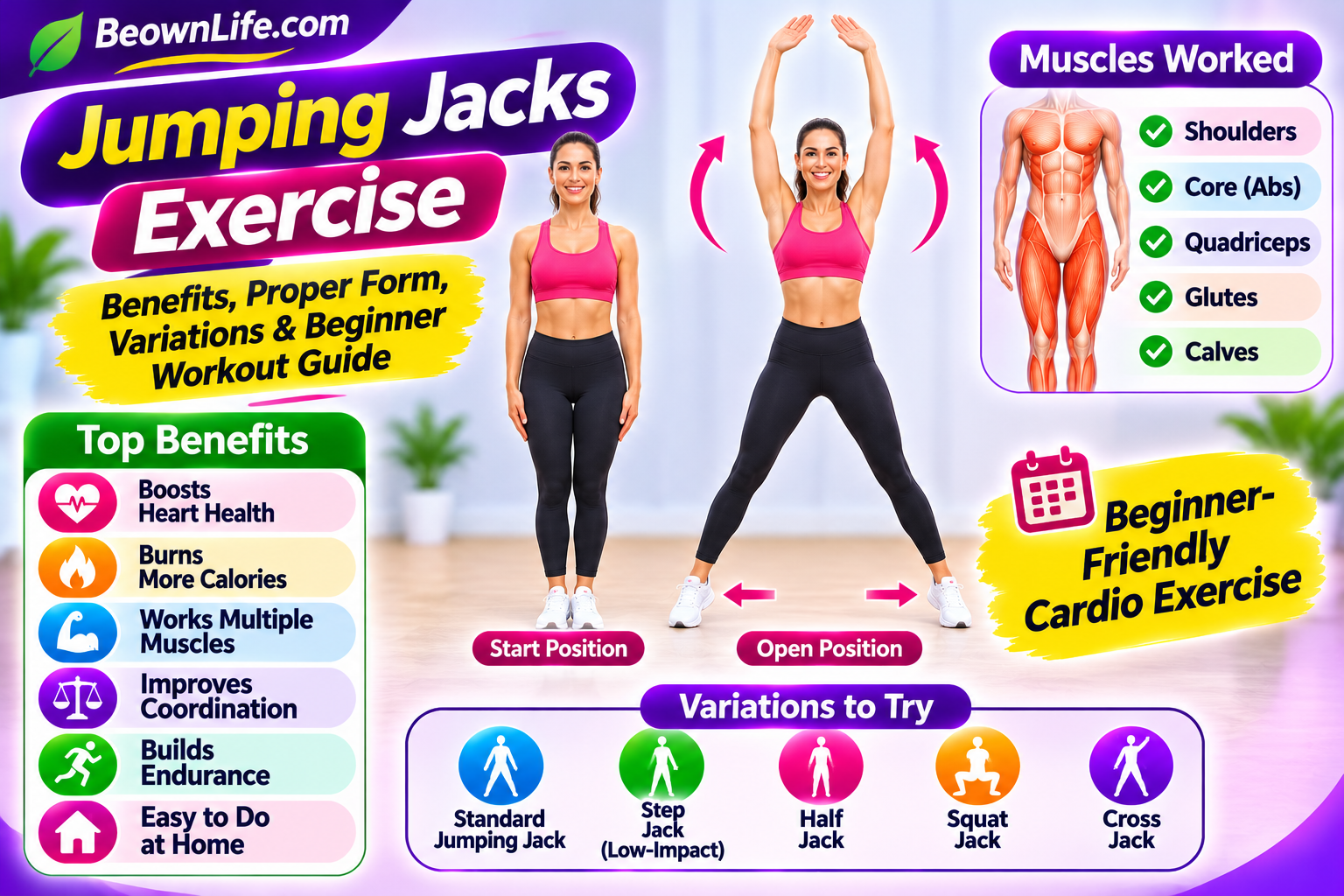
Jumping jacks are one of the most recognizable cardio exercises in the world. They require no special equipment, take up very little space, and can be performed at home, in the gym, or outdoors. Whether you are starting a fitness routine or looking for a quick warm-up, jumping jacks can be a convenient addition to your workout.
This classic exercise combines repeated jumping with coordinated arm and leg movements. It raises your heart rate, engages several muscle groups, and challenges your balance and coordination. Because the movement can be modified, people can choose a version that matches their current fitness level.
In this guide, you will learn how to do jumping jacks correctly, which muscles they work, their potential benefits, common mistakes, beginner-friendly variations, and how to include them in a practical workout routine.
⚡ Jumping Jacks at a Glance
Cardio
Beginner to Advanced
None
Cardiovascular Fitness
Suggested starting point: Try 2 sets of 10–15 controlled repetitions, or 15–20 seconds of movement, with rest between sets. Adjust according to your fitness level.
What Are Jumping Jacks?
Jumping jacks are a full-body cardiovascular exercise performed by jumping from a standing position into a wide stance while raising both arms overhead, then jumping back to the starting position while lowering the arms.
The exercise involves a repeated opening-and-closing movement. Your legs move outward and inward while your arms move upward and downward in coordination. This rhythmic pattern challenges your cardiovascular system while engaging muscles throughout your body.
Jumping jacks are often used in warm-ups, aerobic workouts, circuit training, and home fitness routines. They can also be modified into low-impact step jacks for people who want to avoid jumping.
Which Muscles Do Jumping Jacks Work?
Jumping jacks engage several muscle groups at the same time. Although the exercise is primarily cardiovascular, your legs, shoulders, core, and stabilizing muscles all contribute to the movement.
🦵 Quadriceps
Help straighten your knees and support the landing and jumping movements.
🍑 Glutes
Assist with hip movement and help control your lower-body position.
🦶 Calves
Contribute to pushing off the ground and absorbing impact when landing.
💪 Shoulders
Raise and lower your arms during each repetition.
🧘 Core Muscles
Help stabilize your torso and maintain an upright posture.
Upper Back
Contributes to shoulder control and maintaining comfortable arm movement.
10 Potential Benefits of Jumping Jacks
When performed consistently as part of a balanced exercise routine, jumping jacks can offer several fitness benefits. Your results depend on exercise intensity, duration, consistency, and overall lifestyle.
1. Supports Cardiovascular Fitness
Jumping jacks are an aerobic movement that can increase your heart rate. Regular aerobic activity can improve cardiovascular fitness and help your heart and lungs work more efficiently over time.
2. Helps Improve Stamina
Repeating jumping jacks over time challenges your endurance. Gradually increasing your workout duration can help you build the stamina needed for other physical activities.
3. Engages Multiple Muscle Groups
The coordinated movement activates your legs, glutes, shoulders, and core. This makes jumping jacks a practical full-body movement for general fitness.
4. Supports Coordination
Your arms and legs must move together in a repeated pattern. Practicing this movement can help develop body coordination and movement control.
5. Can Be Part of a Weight-Management Routine
Jumping jacks use energy and can contribute to your daily physical activity. Combined with a balanced diet and consistent exercise, they may support weight-management goals. However, they do not specifically burn belly fat.
6. Requires No Equipment
You do not need dumbbells, machines, or expensive fitness equipment. A suitable amount of space and comfortable shoes may be enough to get started.
7. Makes Warm-Ups More Dynamic
At an appropriate intensity, jumping jacks can be used in a dynamic warm-up to prepare your body for exercise. Start gently and increase the pace gradually.
8. Easy to Add to Home Workouts
Because jumping jacks require little space and no equipment, they are easy to include in home workouts, short exercise breaks, or circuit routines.
9. Supports General Physical Activity
Short sessions of jumping jacks can help you add more movement to your day, especially when combined with walking, strength training, and other forms of exercise.
10. Offers Flexible Workout Options
From beginner step jacks to faster variations, you can adjust the exercise to match your ability, available space, and workout goals.
How to Do Jumping Jacks Correctly
Good technique helps you move efficiently and manage the impact on your joints. Follow these steps to perform a standard jumping jack.
STEP 1
Start in a Standing Position
Stand upright with your feet together, arms relaxed by your sides, chest lifted, and eyes looking forward.
STEP 2
Jump Your Feet Outward
Jump gently and move both feet outward into a comfortable wide stance. Avoid landing with your knees locked.
STEP 3
Raise Your Arms Overhead
As your feet move apart, swing both arms outward and upward. Bring your hands toward each other above your head without forcing your shoulders.
STEP 4
Jump Back to the Starting Position
Jump your feet back together while lowering your arms to your sides in a controlled movement.
STEP 5
Repeat at a Comfortable Pace
Continue the opening-and-closing movement. Maintain a steady rhythm and breathe naturally throughout the exercise.
💡 Form Tip:
Land softly with slightly bent knees, keep your movements controlled, and choose a pace that allows you to maintain good technique.
7 Jumping Jacks Variations to Try
There is more than one way to perform jumping jacks. These variations allow you to change the intensity or movement pattern according to your fitness level.
1. Standard Jumping Jacks
The traditional version with both feet jumping apart and together while the arms move overhead and back down.
Best for: General cardio fitness.
2. Step Jacks
Step one foot out at a time instead of jumping. Move your arms upward and downward in a similar pattern.
Best for: Low-impact workouts.
3. Half Jacks
Keep your arm movement below shoulder level or use a smaller range of motion while performing the leg movement.
Best for: A modified movement pattern.
4. Squat Jacks
Begin in a shallow squat and jump your feet apart and together while maintaining a controlled squat position.
Best for: A more challenging lower-body workout.
5. Cross Jacks
Alternate crossing one foot in front of the other and then switching the foot position. Coordinate your arms with the movement.
Best for: Coordination and variety.
6. Low-Impact Front Jacks
Step one foot forward or outward at a time while moving your arms. Avoid jumping and keep the movement comfortable.
Best for: People who prefer less impact.
7. Power Jacks
Perform a more energetic jumping jack with a slightly deeper squat on landing. Use only if you have the strength and control for higher-impact movements.
Best for: Experienced exercisers.
Common Jumping Jacks Mistakes to Avoid
Even a simple exercise can become uncomfortable when performed with poor technique. Watch out for these common mistakes:
❌ 1. Landing with Stiff Knees
Landing with locked knees can increase impact. Keep a slight bend in your knees and land gently.
❌ 2. Moving Too Quickly
Speed should never come at the expense of control. Start slowly and increase your pace only when your form remains consistent.
❌ 3. Using an Uncomfortable Arm Range
Do not force your arms overhead if your shoulders feel uncomfortable. Use a smaller range of motion when needed.
❌ 4. Ignoring Your Breathing
Avoid holding your breath. Breathe naturally and maintain a pace you can manage.
❌ 5. Exercising on a Slippery Surface
Choose a stable, non-slippery surface with enough room to move. Wear comfortable footwear that provides suitable support.
❌ 6. Doing Too Much Too Soon
Starting with too many repetitions can lead to excessive fatigue. Increase your exercise volume gradually.
How Many Jumping Jacks Should Beginners Do?
The right number depends on your current fitness, comfort, and exercise experience. Beginners should prioritize good technique rather than trying to complete a large number of repetitions.
| Fitness Level | Starting Target | Rest |
|---|---|---|
| Beginner | 10–15 reps | 45–60 seconds |
| Intermediate | 20–30 reps | 30–45 seconds |
| Advanced | 30–50 reps | As needed |
These are example starting targets, not mandatory standards. You can also measure your workout by time, such as 15–20 seconds of movement followed by a recovery period.
4-Week Beginner Jumping Jacks Workout Plan
This gradual plan is designed to help beginners become familiar with the movement. Complete the sessions at a comfortable intensity and allow recovery between workout days.
WEEK 1 – Learn the Movement
- 2 sets of 10 step jacks or comfortable jumping jacks
- Rest 45–60 seconds between sets
- Complete 2–3 sessions during the week
Goal: Learn coordination and comfortable landing technique.
WEEK 2 – Build Consistency
- 2 sets of 12–15 repetitions
- Rest 45 seconds between sets
- Complete 3 sessions during the week
Goal: Improve movement control and build a regular routine.
WEEK 3 – Improve Endurance
- 3 sets of 15–20 repetitions, if comfortable
- Rest 30–60 seconds between sets
- Complete 3 sessions during the week
Goal: Gradually increase your exercise capacity.
WEEK 4 – Strengthen Your Routine
- 3 sets of 20–25 repetitions, if appropriate
- Rest as needed between sets
- Complete 3–4 sessions during the week
Goal: Build confidence and maintain consistent form.
Important: Progress only when the previous level feels manageable. You do not need to reach the highest repetition target to benefit from regular physical activity.
Are Jumping Jacks Good for Weight Loss?
Jumping jacks can contribute to a weight-management plan because they increase physical activity and use energy. However, no single exercise guarantees weight loss.
Weight change is influenced by several factors, including food intake, total daily activity, sleep, health conditions, and consistency. A sustainable approach combines regular exercise with balanced nutrition and healthy lifestyle habits.
🔥 Can Jumping Jacks Burn Belly Fat?
Jumping jacks cannot specifically target belly fat. Fat loss occurs throughout the body and cannot be directed to one particular area through a single exercise. They can still be part of a broader routine that supports overall weight management.
How Many Calories Do Jumping Jacks Burn?
The number of calories burned during jumping jacks varies from person to person. Factors include body weight, exercise duration, movement speed, intensity, fitness level, and rest periods.
Because these factors vary significantly, there is no single calorie-burn figure that applies to everyone. A fitness tracker may provide an estimate, but it should not be treated as an exact measurement.
For a more useful comparison, focus on how long you exercise, how challenging the session feels, and how consistently you complete your workouts.
Are Jumping Jacks Suitable for Beginners?
Yes. Many beginners can start with a modified version called step jacks. Instead of jumping both feet outward and inward, you step one foot to the side and bring it back while coordinating your arms.
This version reduces jumping impact and makes it easier to control the movement. Once you feel comfortable and have no discomfort, you may gradually try the standard version.
Beginner Tip:
Start with 15–20 seconds of step jacks, rest, and repeat if comfortable. Keep your movement controlled rather than rushing to complete more repetitions.
Safety Tips and Who Should Be Careful
Jumping jacks are a high-impact exercise in their standard form. Although many healthy adults can perform them, the repeated jumping may not be suitable for everyone.
- Warm up with gentle movement before starting.
- Use supportive footwear and a stable surface.
- Keep enough space around you to move safely.
- Land softly and avoid locking your knees.
- Start with a low-impact variation if jumping feels uncomfortable.
- Stop if you experience pain, dizziness, unusual shortness of breath, or chest discomfort.
People with joint problems, balance difficulties, recent injuries, or medical conditions that affect exercise tolerance should consider speaking with a healthcare professional before starting a high-impact routine. If you are pregnant or returning to exercise after childbirth, choose an appropriate exercise variation with guidance from your healthcare professional.
⚠️ Safety Reminder
Stop exercising and seek urgent medical attention if you experience chest pain, fainting, or severe or unusual breathing difficulty. Do not try to push through these symptoms.
Frequently Asked Questions About Jumping Jacks
1. What are jumping jacks good for?
Jumping jacks are useful for cardiovascular exercise, general endurance, coordination, and engaging multiple muscle groups. They are also convenient for warm-ups and home workouts.
2. How many jumping jacks should I do a day?
Beginners can start with 10–15 repetitions per set or short intervals of 15–20 seconds. Your daily amount should depend on your fitness level, recovery, and overall exercise routine.
3. Do jumping jacks help lose belly fat?
They can contribute to overall physical activity and energy expenditure, but they do not specifically target belly fat. Sustainable fat loss depends on overall lifestyle and energy balance.
4. Can I do jumping jacks every day?
Some people may tolerate light sessions frequently, but recovery is important. Vary your exercise intensity and allow rest when your muscles or joints feel tired or uncomfortable.
5. Are jumping jacks a cardio exercise?
Yes. Standard jumping jacks are an aerobic movement that can raise your heart rate and challenge cardiovascular endurance.
6. Do jumping jacks work the abs?
Your abdominal and other core muscles help stabilize your torso during the exercise. However, jumping jacks are not a substitute for targeted abdominal strength exercises.
7. Are jumping jacks bad for your knees?
They are not automatically harmful, but repeated jumping can be uncomfortable for people with certain knee conditions. Step jacks offer a lower-impact alternative.
8. Can older adults do jumping jacks?
Some older adults may be able to perform modified step jacks, depending on their balance, mobility, and health. A healthcare professional or qualified exercise specialist can help identify a suitable option.
9. Do jumping jacks build muscle?
They activate several muscles, especially in the legs and shoulders, but they are primarily a cardiovascular exercise. Progressive resistance training is more effective for building muscle strength and size.
10. What can I do instead of jumping jacks?
Step jacks, marching in place, side steps, and low-impact aerobic movements can be alternatives. Choose the option that feels comfortable and matches your fitness level.
Final Thoughts
Jumping jacks are a simple, accessible, and versatile cardio exercise that can fit into many fitness routines. They engage several muscle groups, challenge your cardiovascular system, and help develop coordination and endurance.
Whether you choose standard jumping jacks or a low-impact step-jack variation, consistency and proper technique matter more than the number of repetitions you complete.
Start at your own pace, listen to your body, and gradually build a routine that supports your long-term fitness goals.
References and Further Reading
- CDC – Physical Activity Guidelines for Adults
- World Health Organization – Physical Activity
- American Heart Association – Fitness and Physical Activity

