


💡 Quick Answer: What is a Plank?
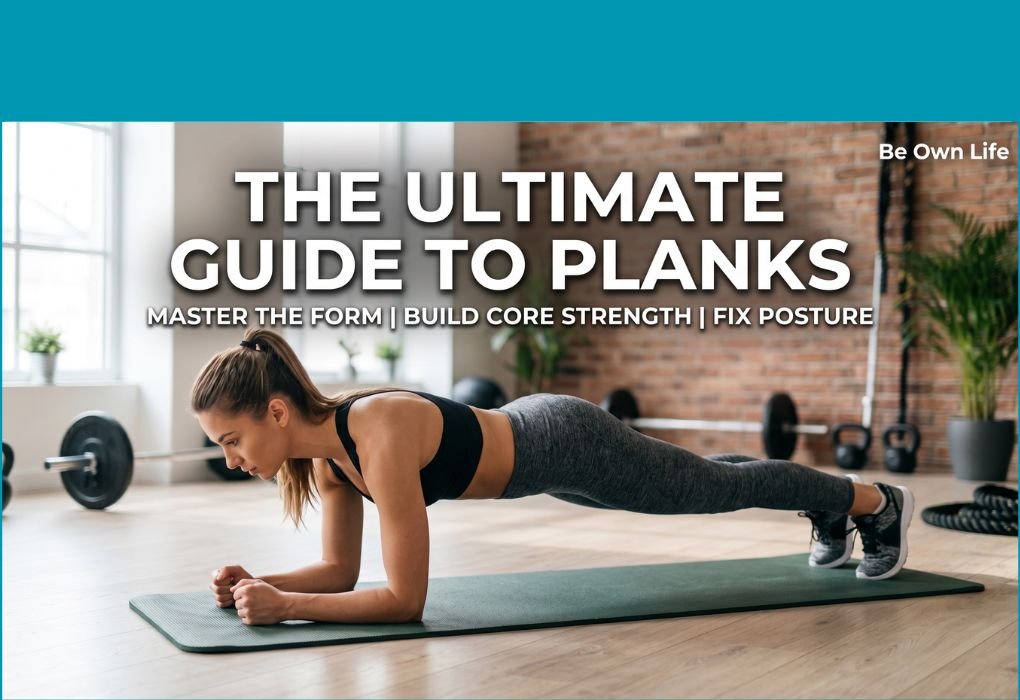
A plank is an isometric core strength exercise that involves maintaining a position similar to a push-up for a set period of time. Rather than moving through a range of motion, the plank requires you to hold your body in a straight, rigid line. It heavily targets the deep abdominals, obliques, lower back, shoulders, and glutes, making it one of the most efficient total-body stabilizers available.
If you are still doing hundreds of crunches to build a stronger core, it might be time to update your routine. Fitness professionals have largely moved away from traditional sit-ups, and they’ve replaced them with something much more challenging, much safer for your spine, and infinitely more effective: the plank.
Here at Be Own Life, we are all about exercises that deliver maximum results with minimal equipment. The plank is the undisputed king of isometric holds. It doesn’t just build the visible “six-pack” muscles; it fortifies the deep, invisible core muscles that dictate your posture and protect your back.
But while the plank looks like you are just holding still, there is an intense full-body battle happening under the surface. Let’s break down how to execute the perfect plank so you can stop wasting time and start building real core power.
🏋️♂️ How to Hold a Perfect Forearm Plank
Most people fail at planks not because their abs are weak, but because their form falls apart. A sloppy plank is practically useless and can actually strain your lower back. Here is how to lock in your form:
- The Setup: Get down on the floor and place your forearms flat on the ground. Your elbows should be stacked perfectly underneath your shoulders. Your forearms can be parallel, or you can clasp your hands together.
- The Extension: Step your feet back one at a time until your legs are fully extended. Rest your weight on your toes.
- The Core Engagement: This is the most crucial step! Tuck your pelvis slightly (like a dog tucking its tail) to flatten your lower back. Squeeze your glutes, flex your quads, and brace your abs as if you are about to be punched in the stomach. Pro Tip: Do not let your hips sag toward the floor, and don’t pike your butt up toward the ceiling. You want a straight line!
- The Breathing: Keep your neck neutral by looking at the floor slightly ahead of your hands. Breathe deeply and evenly. Do not hold your breath!
“A plank isn’t just an ab exercise. You should be actively squeezing your glutes, driving your elbows into the floor, and flexing your thighs. Make it an active, full-body contraction.”
🔰 Beginner-Friendly Plank Variations
If a standard forearm plank on your toes is too difficult right now, that is completely okay! Form is more important than duration. Try these fantastic starting points:
- The Incline Plank: Place your forearms (or hands) on a sturdy elevated surface like a bench, a couch, or even a countertop. The higher the surface, the less gravity pulls on your core, making the hold much easier to manage.
- The Knee Plank: Get into the standard forearm plank position, but drop your knees to the mat. Make sure you still maintain a straight line from your head to your knees—don’t let your hips pop up into a tabletop position.
- The High Plank: Instead of resting on your forearms, push up onto your hands (exactly like the starting position of a push-up). For many people, this is slightly easier on the core than a forearm plank, though it does demand more shoulder stability.
🔥 The Huge Benefits of Planking
Why do trainers universally program the plank? Because it trains your core to do exactly what it was designed to do: stabilize your spine.
1. Builds a Functional, Deep Core
Planks target the transverse abdominis—the deep core muscles that act like a natural corset. Strengthening this muscle pulls your waistline in and provides structural support for heavy lifting.
2. Improves Posture & Alignment
By strengthening your back, chest, shoulders, neck, and abs all at once, planks make it significantly easier to keep your shoulders pulled back and stand up straight throughout the day.
3. Drastically Reduces Back Pain
Unlike crunches, which repeatedly flex your spine and can cause disc damage, planks build abdominal strength in a neutral spine position, acting as armor against lower back injuries.
🤔 Who Are Planks Suitable For?
Planks are highly recommended for almost everyone.
Whether you are a runner looking for better pelvic stability, a desk worker trying to reverse the slump, or a weightlifter bracing for heavy squats, planks are essential. However, if you are pregnant, have a history of hernias, or are recovering from recent abdominal surgery, you should consult with a doctor or physical therapist before performing planks.
❓ Frequently Asked Questions (FAQ)
How long should I hold a plank?
Quality beats quantity! It is much better to hold a perfect, intensely squeezed plank for 20-30 seconds than a sloppy, sagging plank for 2 minutes. Aim to build up to 3 sets of 60 seconds with flawless form.
Why does my lower back hurt when I plank?
Lower back pain means your core has “turned off” and your lower back is taking all the weight. This usually happens when your hips sag. To fix it, squeeze your glutes tighter and tuck your pelvis. If the pain persists, drop to your knees.
Do planks burn belly fat?
Planks build and tone the muscles underneath the fat, but you cannot spot-reduce belly fat with any exercise. Fat loss comes from a combination of a healthy diet, caloric deficit, and overall activity. However, a stronger core will make your midsection look tighter and more athletic!
Written by the Be Own Life Editorial Team
At Be Own Life, we are dedicated to bringing you practical, science-backed lifestyle and wellness advice. Our content is reviewed by fitness advocates and health enthusiasts to ensure you get safe, effective, and actionable tips to build your best life.

